
Does Your Startup Really Need an HR Department? The Bolt CEO's Case for Saying No — And What Founders Should Actually Do
square.jpg)


"Ryan Breslow, the 31-year-old founder and CEO of fintech company Bolt, said something at Fortune's Workforce Innovation Summit that broke the internet — at least in startup circles. He said he fired his entire HR department, and the moment he did, the company's problems disappeared."
Not some of the problems. Not most of them. All of them.
“We had an HR team, and that HR team was creating problems that didn’t exist. Those problems disappeared when I let them go.” — Ryan Breslow, Bolt CEO
That kind of statement is either the boldest executive truth-telling in recent memory, or a convenient way to deflect blame onto people who can no longer defend themselves. Probably a bit of both. Either way, it raises a real question that every startup founder eventually has to answer: does having an HR department actually help your company, or does it quietly make things worse?
This article breaks down Breslow's reasoning, the real case for and against HR in early-stage companies, and the risks that come with going without it — now and down the road.
The Bolt Context: What Actually Happened
To understand Breslow's decision, you need the full picture. Bolt had one of the more spectacular startup collapses of the last decade. In 2022, the e-commerce checkout company was valued at $11 billion. By 2024, that number had cratered to around $300 million — a 97% drop. Breslow stepped down as CEO in 2022 amid the chaos. He returned in 2025 to what he described as a company that needed to operate in "wartime" mode.
When he came back, he cut 30% of the workforce. He eliminated four-day work weeks. He got rid of unlimited PTO, replacing it with a mandatory four-week policy because he found top performers weren't taking enough rest while underperformers were exploiting the vagueness. He fired nearly the entire leadership team.
And then he fired HR.
In its place, Bolt built a smaller "people operations" team focused specifically on training and employee support — not policy management, not culture enforcement, not managing feelings.
Breslow's diagnosis was simple: during Bolt's boom years, a culture of entitlement had set in. Employees had good salaries, generous perks, and an HR team that prioritized comfort over accountability. The HR department, in his view, had become a buffer that insulated underperformers from consequences.
"There's a sense of entitlement that had festered across the company," he said. When he gave employees 60 days to adapt to the new culture, 99% of them couldn't make the shift.
What Breslow Was Really Saying
Breslow wasn't making an argument that HR is universally useless. He was more precise than that — and the nuance matters.
He acknowledged directly: "Those HR professionals have really important insights when you're in peacetime and when you're at a larger company." The problem wasn't HR as a concept. The problem was traditional HR in a startup that needed to operate like a lean, fast-moving machine.
His LinkedIn post put it plainly: "HR is the wrong energy, format, and approach." People operations, by contrast, was described as a structure that empowers managers and streamlines decisions rather than creating new layers of process.
The distinction he's drawing is between HR as a compliance and comfort function versus people operations as an execution and performance function. One is built for stability. The other is built for speed.
For a company that went from $11 billion to $300 million and needed to rebuild fast, stability functions weren't just unnecessary — they were actively counterproductive.
The Real Problems HR Creates in Startups
Breslow's experience isn't unique. Many founders have felt the friction. Here's what traditional HR structures genuinely tend to do wrong in early-stage companies:
• Process becomes a substitute for judgment. HR departments often build policy frameworks before a startup has enough operational data to know what policies it actually needs. The result is rules that don't fit the reality.
• HR protects the wrong people. When underperformers know how to navigate HR processes — and many do — it becomes harder and slower to remove them. The process that exists to protect employees can inadvertently protect the wrong ones.
• Accountability gets bureaucratized. Managers stop having direct conversations with their people because every difficult conversation has to go through HR channels. Speed of feedback slows down. Culture gets managed by document rather than by relationship.
• Compliance culture can crush performance culture. When HR is primarily focused on legal risk and employee grievances, the signal it sends to the team is that the company's main job is to protect itself — not to win.
• HR attracts its own kind of entitlement. Departments that exist to "support" employees can become politically powerful inside a company in ways that don't serve the mission. If HR sets the culture, the culture tends to optimize for HR's comfort, not for the company's output.
The Real Case for Having HR — Even at a Startup
Before founders start cleaning house, they need to be honest about what HR actually does when it's done right. Because the risks of operating without it are real.
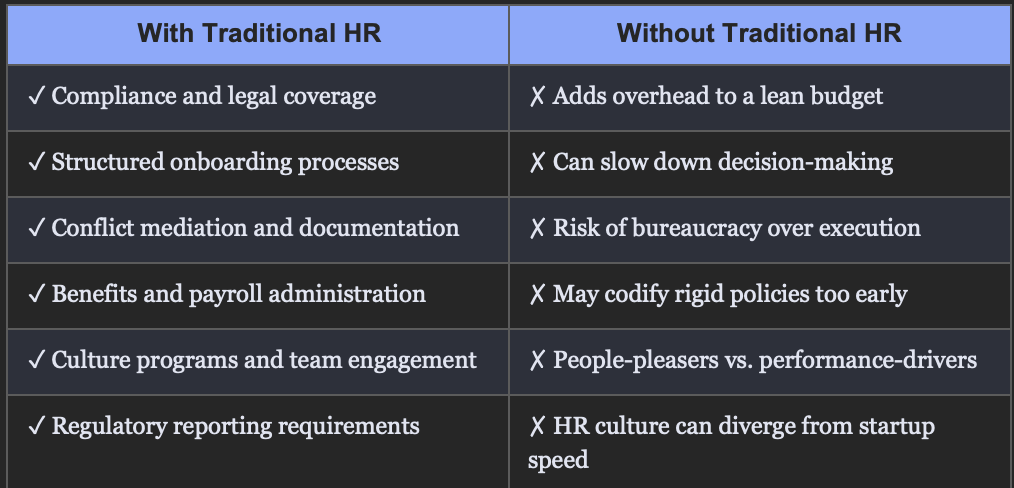
The table above is a summary, but here's the harder truth: most of the "benefits" column matters a lot more once your headcount crosses 20 to 30 people. Before that, a strong founder and good managers can handle most of it. After that, the cracks start to show.
Labor law compliance is not optional regardless of your stage. A single wrongful termination lawsuit, a sexual harassment claim that wasn't documented properly, or a misclassification issue with contractors can cost a startup more than a full HR team's annual salary. The risk isn't theoretical.
Benefits administration — health insurance, payroll compliance, tax filings — is genuinely complex and can't be willed away by startup energy. Someone has to own it.
And diverse, growing teams are harder to manage than small, homogeneous ones. Conflict happens. Bias happens. If there's no one equipped to handle it, founders handle it badly or don't handle it at all, which is often worse.
Why Breslow's Move Made Sense — In His Specific Situation
Here is the context most coverage of this story skips: Bolt wasn't a seed-stage startup. It was a company coming off a spectacular boom-and-bust cycle, bloated with comfort culture, trying to survive.
In that context, traditional HR wasn't just unnecessary overhead. It was an active obstacle. HR was the institutional memory of the entitlement era. It held the policies, the norms, the processes, the culture that had allowed the company to lose 97% of its value while people felt entitled.
Blowing it up wasn't reckless. It was surgical. You cannot rebuild a performance culture by layering new expectations onto the old infrastructure. You have to clear the infrastructure first.
His replacement — a lean people operations team focused on training and employee support — isn't the absence of people management. It's a different form of it. One built for execution rather than comfort.
Founders who read Breslow's story as permission to ignore their people management needs are missing the point. He didn't eliminate people management. He replaced one model with a leaner, more execution-focused one.
The Challenges That Will Come Without Traditional HR
Even if the Breslow model makes sense for Bolt right now, it comes with real risks that founders need to plan for. None of these are reasons not to do it — but all of them are reasons to think carefully.
Legal Exposure Doesn't Care About Your Culture Reset
Without a dedicated compliance function, the risk of employment law violations rises. This includes everything from improper terminations and discrimination claims to FMLA violations and misclassified contractors. Breslow has access to legal counsel and a finance team. Early-stage founders often don't. Operating without HR requires someone to own the legal exposure intentionally.
Scaling Gets Harder Without Systems
People operations teams work well at 50 to 100 people. At 300 or 500, the lack of structured HR processes becomes a real operational problem. Onboarding breaks down. Compensation equity drifts. Career paths become unclear. The founders who succeed without HR tend to build people systems into their management structure anyway — they just don't call it HR.
The Talent Market Is Watching
Top candidates do their research. A company known for firing its entire HR department and operating in "wartime" mode will attract a specific kind of candidate — and repel others. That's not necessarily wrong, but it's a brand statement that shapes who applies and who accepts offers.
Culture by Founder Is Not Culture by Design
When the CEO is the culture, the culture is as stable as the CEO's mood and tenure. Institutionalizing values — making them survive beyond the founding team — is genuinely hard without some people infrastructure. Breslow has a strong personal brand that can carry Bolt right now. But that doesn't scale indefinitely.
What Happens When Something Goes Wrong?
A serious harassment allegation, a mental health crisis in the team, a high-profile wrongful termination — when these happen in companies without HR, they land on the CEO's desk with no documentation, no policy framework, and no trained person to handle them. The people operations team Bolt replaced HR with may cover some of this, but not all of it.
What Startup Founders Should Actually Do
Breslow's move was the right call for a specific company at a specific moment. For founders earlier in the journey, the lesson is more nuanced than "don't hire HR."
• 0–15 people: You don't need an HR department. You need a founder who can have direct conversations, a basic employee handbook, and a payroll and benefits provider.
• 15–40 people: You need a people operations generalist — someone focused on onboarding, compensation, and culture basics. Not a traditional HR function, but someone who owns people systems.
• 40–100 people: You need proper HR infrastructure. Not necessarily a big team, but clear processes, documented policies, compliance coverage, and management training.
• Post-crisis or turnaround mode: Breslow's playbook becomes relevant. If your company has developed entitlement culture or political dysfunction, the people infrastructure may be reinforcing it. You may need to rebuild from scratch.
The through-line in all of this is that the question isn't "should I have HR?" — it's "what do I actually need my people function to do, and is the structure I have built to do that?"
Traditional HR is built for peacetime at scale. Startups rarely live in peacetime. The best founders treat people management as a tool they design intentionally, not a department they hire out of obligation.
The Bottom Line
Ryan Breslow's decision to fire Bolt's HR department wasn't anti-people. It was a specific diagnosis of a specific disease — an entitlement culture that had embedded itself in company infrastructure — and a targeted intervention to cut it out.
The problems didn't disappear because HR is useless. They disappeared because the version of HR Bolt had was the institutional anchor of a culture that was killing the company.
For startup founders, the real takeaway is this: people management matters more in a startup than in any other environment, because your team is your only real asset. The question is whether the way you're doing it is making the team stronger or slowing it down.
Breslow's answer was that his HR setup was slowing everything down. Your answer might be different. But you should be honest enough to ask the question.
Read - Your Idea Is Not Enough: Why "I Found a Problem" Is No Longer Enough to Start a Startup in 2026





Weekly
Newsletter.
