
The Boring Discipline Behind Nvidia's Streak, and What It Actually Teaches Founders
square.jpg)

A Beat That Barely Moved the Market
Nvidia generated 96.22 billion dollars in revenue last quarter. It beat Wall Street. It beat its own guidance. Its data center business, now roughly 92 percent of everything the company sells, grew 117 percent year over year. And yet the most interesting thing about the quarter was not how much Nvidia made. It was how little surprise the market seemed to feel about a number that would have sounded fictional five years ago.
The stock rose about 4 percent as executives walked through the results on the August 26 call, then gave that back over the following days and fell alongside the rest of the semiconductor sector amid a broader risk-off move tied to AI infrastructure spending worries elsewhere in the industry. Nvidia has now beaten Wall Street's revenue and earnings estimates for five straight quarters, and its stock has fallen after four of those five reports.
The company keeps delivering some of the largest quarters in corporate history. The market keeps asking a harder question anyway.
That question, not the revenue figure, is where the founder lesson actually lives. The Nvidia lesson is not to grow faster. It is that extraordinary growth eventually becomes ordinary to the people watching you, and the companies that survive that transition are the ones that replace surprise with reliability.
Nvidia is worth studying not for the size of its numbers but for the specific, repeatable habits it uses to keep being believed at a scale where belief gets harder to earn every quarter.
The Shrinking Beat and the Expectations Tax
It helps to separate three things that get blended together in most earnings coverage. The first is execution: did Nvidia deliver what it said it would. The second is expectations: did it deliver more than investors had already priced in before the report. The third is narrative durability: do investors believe this level of execution can continue.
Nvidia has spent three years dominating the first layer. What makes this cycle genuinely interesting is that it is now struggling with the second and third layers despite never failing the first.
Consider the pattern in Nvidia's own guidance discipline. Analysts and trackers who follow the company's results against its prior-quarter guidance have documented beats as large as 22.8 percent earlier in this AI cycle, narrowing to 5.7 percent against the midpoint this quarter and 4.5 percent against Wall Street consensus.
Revenue still more than doubled year over year. The beat got smaller because the number being beaten has grown enormous, not because execution slipped.
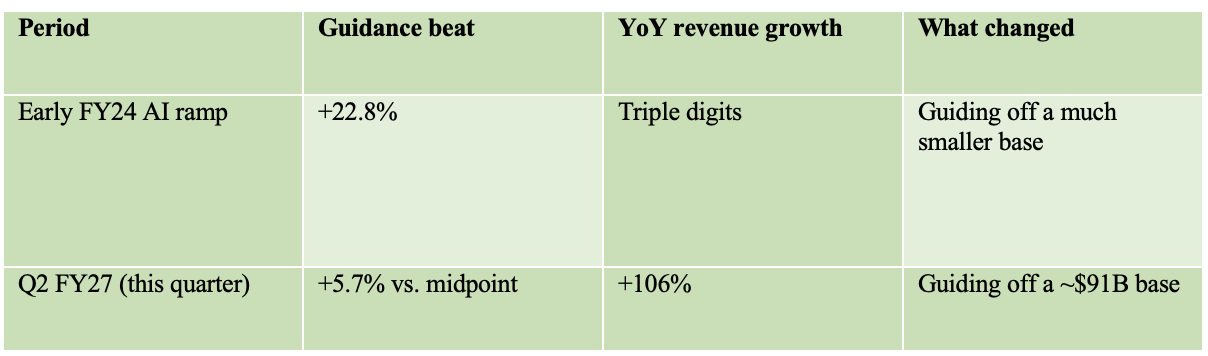
That compression is the source of what is worth calling the expectations tax. When a young company grows 100 percent, the market calls it extraordinary. When a company Nvidia's size grows 106 percent, part of the market starts asking why it was not 110. Early-stage companies mostly compete against their own past performance. Mature companies increasingly compete against the expectations created by their own past performance, a much harder opponent because it grows every time you beat it.
Nvidia's specific response has been to keep guidance conservative enough to clear reliably, then let the business close the gap by a shrinking but positive margin, which is a less exciting story than a single blowout quarter and a far more valuable one to a customer or investor trying to model the business three years out.
That credibility is what let CFO Colette Kress do something notable on this call: give a multiyear growth forecast, projecting roughly 70 percent revenue growth for fiscal 2028, well above the roughly 44 percent analysts had modeled. She was explicit that the number was not a demand estimate but a supply ceiling.
Customer forecasts, she said, pointed to demand roughly doubling, but Nvidia's own manufacturing and memory supply could only confidently support 70 percent growth. A company that had missed its own guidance even once in the recent past could not make that statement and be believed. Nvidia could, because it had spent three years proving the number it says out loud is the number that actually happens.
Don't Just Own the Product, Own the Bottleneck
The clearest strategic move to come out of this earnings cycle was not in the numbers at all. The same week, Nvidia was reported to have agreed to acquire Hugging Face, the open-source hub where millions of developers build, host, and share AI models, for 12.9 billion dollars, according to The Information, and matched by CNBC, TechCrunch, and Fortune. Neither company has confirmed a signed deal, and Business Insider's reporting says talks could still fall apart.
Treat the figure as a strong, multi-sourced report, not a closed transaction. What is worth analyzing regardless of whether it closes is the pattern it fits. Nvidia had already offered 500 million dollars for a stake in Hugging Face in late 2025, valuing the company at 7 billion dollars, and been turned down. Less than a year later it was reportedly willing to pay nearly twice that for the whole company, against a business generating an estimated 100 to 150 million dollars in annual revenue.
If the reported price holds, that is something like 90 times revenue, a multiple that only makes sense if the target is not the revenue but the position: the layer where developers choose which AI models to build on, sitting one step upstream of the hardware Nvidia sells to run those models.
That is one entry in a longer pattern. A GPU is worth more as part of a system than on its own, which is why Nvidia has spent years buying its way up and down the stack around the chip itself: compute, then the networking that connects chips together, then the software that keeps developers loyal to that hardware, then the inference layer that runs the finished models, then, potentially, the ecosystem where the models themselves get built and shared.
Nvidia's 6.9 billion dollar purchase of the networking company Mellanox in 2019 secured the second layer, giving it control over how thousands of GPUs talk to each other inside a data center, a detail that matters enormously once a single training run spans an entire warehouse of chips. CUDA, Nvidia's software platform, secured the third layer years earlier, becoming the toolkit a huge share of AI developers already write their code against, which raises the cost of ever switching to a competitor's hardware regardless of how good that hardware is on paper.
In December 2025, Nvidia moved on the inference layer, structuring a 20 billion dollar deal with the AI chip startup Groq as a non-exclusive licensing agreement rather than an acquisition. Groq's founder, its president, and other members of its team joined Nvidia to help scale the licensed technology, while Groq nominally continued operating as an independent company under a new chief executive.
Analysts were candid that the structure looked designed to capture Groq's technology and talent while avoiding the longer antitrust review a straightforward acquisition might invite. Whatever the motive, the deal demonstrates something more transferable than the price tag: Nvidia did not need to buy the entire company to absorb the part of it that mattered.
Taken together, these moves suggest a broader strategic instinct rather than a stated Nvidia policy: the company appears increasingly interested in controlling the layers around its core product before those layers become bottlenecks it does not control, or leverage a rival could use against it.
Make the Customer's Future Easier to Plan
Nvidia's other advantage is operational rather than financial. The company is running two product generations in view of its customers at once: Blackwell, still growing and expected to generate roughly 135 billion dollars this year, and Rubin, the next architecture, already shipping to customers including AWS and CoreWeave. The single most useful detail buried in Nvidia's new Vera Rubin hardware is not a performance benchmark.
It is that the new rack-scale system can be installed in about five minutes, down from roughly two hours for the previous generation. Almost anyone can understand what that means, and at Nvidia's volume, a savings of nearly two hours multiplied across thousands of deployments becomes real, budgetable time back for every customer building a data center around the hardware.
That is the more transferable idea than any specification sheet: the best enterprise products do not only perform better, they create less friction for the customer who has to actually install, integrate, and support them. Deployment friction, measured in installation time, integration effort, and the number of things that can go wrong during a rollout, is a cost most founders underweight next to features and price, and it is one large enterprise buyers weigh constantly.
The roadmap itself matters for a related but distinct reason. Announcing a multi-year chip architecture in advance is not unusual in semiconductors. Actually hitting each date on that roadmap at Nvidia's scale is what let AWS commit to two million additional GPUs the same week, without waiting to see whether the next generation would actually arrive on schedule. The lesson here is not that founders should publish ambitious roadmaps and hope to hit them.
Publishing a date you are not confident you can hit is a good way to train customers to discount everything else you tell them. The more useful version of the lesson is to publish a roadmap once you have enough operational confidence to make it genuinely useful for a customer's own planning, and then to treat every date on it as a commitment rather than a marketing aspiration. The value a customer gets from that is not excitement. It is the ability to plan their own capital spending against your calendar instead of their own guesswork.
The Conditions Nvidia Is Not Advertising
None of this is happening in easy conditions, and an honest account of the quarter has to include the parts Nvidia's press release did not lead with. Gross margin, still 75 percent this quarter, is guided down to 74 percent next quarter and a trough of 71 to 72 percent in the fourth fiscal quarter, before recovering to 72 to 73 percent in fiscal 2028, as memory costs that Kress called extreme pricing conditions work their way through the business.
Nvidia shipped less than 1 percent of its data center revenue to China-based customers last quarter under current export rules, and its forward guidance assumes no China data center compute revenue at all. And the fiscal 2028 growth forecast that impressed analysts is, by the company's own description, a ceiling set by what it can manufacture and source in memory, not a reflection of how much its customers actually want. Nvidia's discipline is being tested while it simultaneously manages a supply-constrained ramp, rising component costs, and a geopolitical environment that has already cut off a major market.
There is also a more uncomfortable counterargument worth stating plainly. Nvidia's discipline is not the whole explanation for its results. It is also benefiting from a structural AI infrastructure boom, from limited high-end competition, from CUDA's switching costs, from hyperscaler capital spending that keeps rising rather than plateauing, and from a supply-constrained market that lets it set prices few rivals can match. A founder cannot adopt Nvidia's guidance discipline and expect Nvidia's growth rate to follow.
The discipline is necessary to survive the scrutiny that comes with a position like Nvidia's. It did not create the position in the first place.
What Founders Can Actually Copy
Strip away the trillion-dollar market capitalization and a handful of transferable habits remain. Treat guidance as a promise you engineer to keep rather than a target you hope to hit, since the credibility that compounds from consistently doing so is what eventually lets you make a bigger claim, the way Kress's fiscal 2028 forecast got believed. Look one layer away from your core product for the place a competitor, a supplier, or a customer's own strategy shift could someday cut you off, and move to own or partner into that layer before it becomes a live threat, the logic connecting Mellanox, CUDA, Groq, and the reported Hugging Face talks.
Treat deployment friction as seriously as features or price, since an installation or integration detail a competitor considers a footnote can become a real advantage once it is multiplied across enough customers. And give customers enough visibility into what is coming, backed by dates you actually intend to hit, that they can plan their own future around your calendar rather than around hope.
What does not transfer is the scale that makes those habits so visible: Nvidia's balance sheet, its acquisition capacity, the CUDA ecosystem's decade of accumulated switching costs, and a once-in-a-generation demand cycle that Nvidia did not create and cannot fully control. Most companies will never operate with that kind of structural tailwind at their back, and pretending the discipline alone explains the outcome would be its own kind of overpromising.
The moat isn't the size. It's the reliability. Nvidia's growth rate may be nearly impossible for most companies to reproduce. The habits underneath it, hitting the number you said you'd hit, removing friction customers didn't know they had, watching the layer next to your product, and telling customers what's coming before you ship it, are not.
Sources
NVIDIA Announces Financial Results for Second Quarter Fiscal 2027. NVIDIA Newsroom.
Transcript: Nvidia (NVDA) Q2 FY27 Earnings Conference Call. The Singju Post.
Nvidia CFO Says Demand Points to 140% Growth: Supply Delivers Only Half. Tech Times.
NVIDIA Earnings Q2 FY27: Revenue, Data Center, AI Capex. Rex Shares.
NVIDIA Shares Dropped 7% This Week: 3 Catalysts For the Fall. Yahoo Finance.
Nvidia closes in on Hugging Face acquisition. TechCrunch.
Nvidia agrees to buy Hugging Face for $12.9 billion, report says. CNBC.
Groq and Nvidia Enter Non-Exclusive Inference Technology Licensing Agreement. Groq Newsroom.
Nvidia-Groq deal is structured to keep 'fiction of competition alive,' analyst says. CNBC.
NVIDIA Vera Rubin NVL72. NVIDIA product page.
Nvidia's Margin Pressure Is Micron's Revenue Boost. The Motley Fool.
read - The Seven-Billion-Dollar Neighborhood: What a Cluster of AI-Era Acquisitions Reveals About Strategic Value, and What Founders Should Take From It





Weekly
Newsletter.
