
Cashing in on Your Startup’s Culture Capital
square.jpg)


For many founders, culture begins as an abstract idea — an ideal shared among a few early team members, maybe scribbled on a whiteboard during an all-night brainstorming session. But as your startup grows, that vague notion either blossoms into a powerful strategic asset or dissolves into corporate cliches no one really lives by. In today’s competitive landscape, culture is no longer a “nice to have” — it’s a form of capital that can be leveraged to attract talent, build customer loyalty, and differentiate your brand.
This article explores what culture capital actually is, why it matters now more than ever, and how startups can cash in on it in meaningful ways.
What Is Startup Culture (and What Is Culture Capital)?
At its core, startup culture is the shared set of values, behaviors, norms, and beliefs that shape how a company operates and how people feel about working there. It shows up in how decisions are made, how people communicate, what gets rewarded, and how the company responds to challenges.
Culture capital takes this a step further. It’s the asset-like value derived from your culture — the part of your culture that:
- Customers recognize and connect with
- Employees live and carry forward
- Investors perceive as a competitive advantage
- Partners and communities resonate with
In other words, culture capital is culture that translates into real business outcomes.
Why Culture Matters More Than Ever Right Now
The modern startup environment is more competitive, transparent, and values-driven than ever before. Customers have endless options. Talent can work from anywhere. Investors are more selective. In this context, culture has become a key differentiator.
Brand uniqueness today is no longer defined solely by what you sell, but by who you are. Culture shapes that identity. When a startup clearly stands for something, whether it’s craftsmanship, speed, integrity, community, or innovation, it becomes memorable. That distinctiveness creates an edge that marketing alone cannot manufacture.
Culture is also increasingly tied to trust. Employees want to work for companies whose values align with their own. Customers want to support brands that reflect their beliefs. Investors want to back teams with strong internal cohesion and clarity of purpose. Studies consistently show that companies with strong cultures experience higher engagement, lower turnover, and stronger long-term performance.
In an era of rapid technological change and AI-driven disruption, culture has also become a stabilizing force. While tools and processes evolve quickly, shared values provide continuity. They guide decision-making when there is uncertainty and help teams move in the same direction even as conditions change.
How Startups Can Cash In on Culture Capital
Turning culture into a business advantage isn’t accidental — it requires intentionality. When culture is clearly defined and consistently lived, it becomes a practical tool for growth rather than an abstract ideal. Strong culture influences how people engage with the company at every level, from employees and customers to partners and investors.
One of the first returns on strong culture is talent attraction. Startups with a compelling sense of purpose naturally draw individuals who want more than a paycheck. This alignment improves hiring quality while reducing recruitment effort, allowing founders to build stronger teams without constantly competing on compensation.
Culture also plays a decisive role in employee retention. When people feel connected to a company’s values and mission, they are more likely to stay engaged and committed. This stability preserves institutional knowledge, improves execution, and reduces the costly churn that slows early-stage growth.
Beyond the organization, culture directly impacts customer behavior. Values-driven consumers increasingly support brands that reflect their beliefs. When customers resonate with a startup’s culture, they move from transactional relationships to long-term loyalty, becoming repeat buyers and vocal advocates.
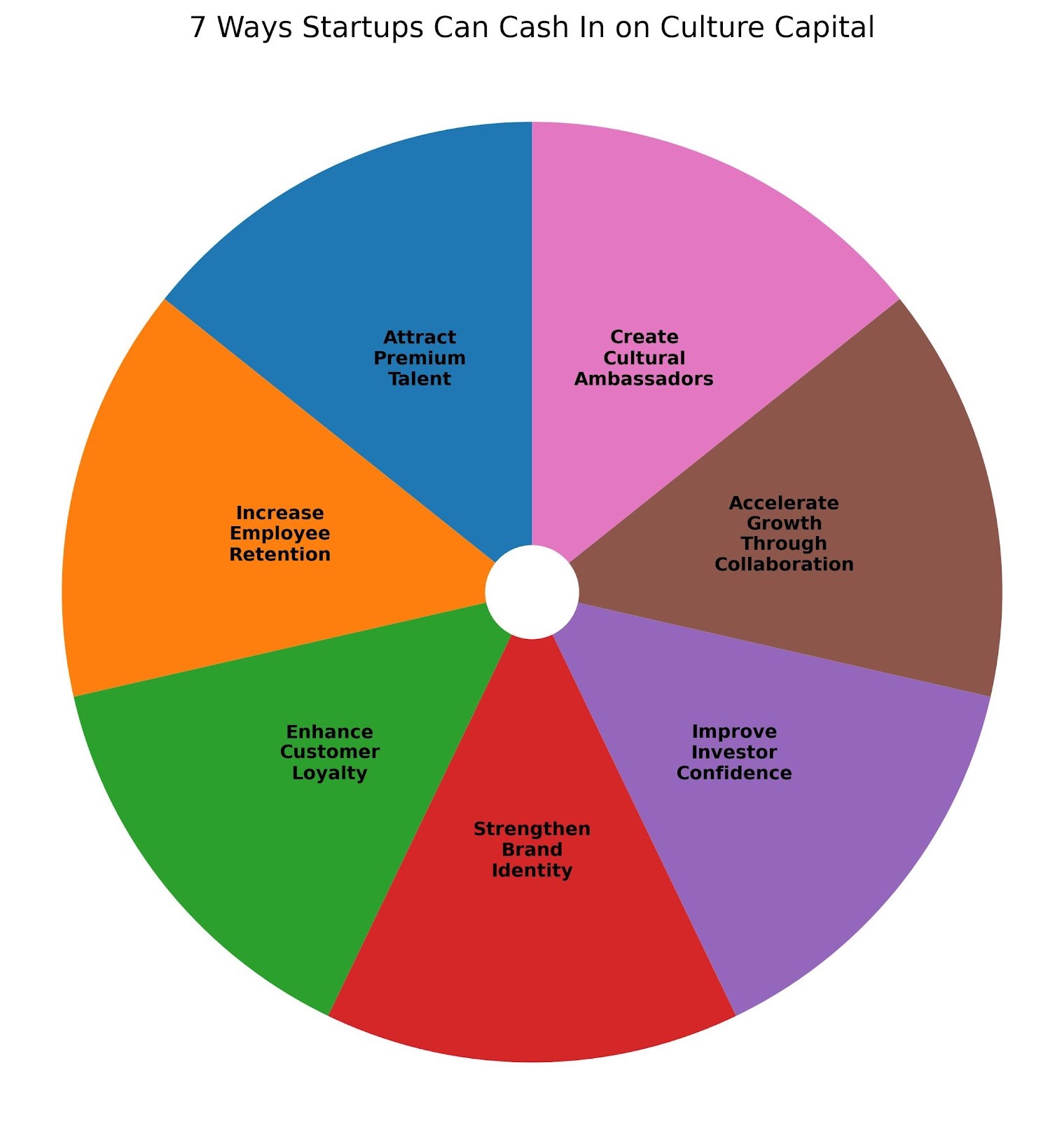
At the brand level, culture ensures consistency. It aligns internal behavior with external messaging, strengthening credibility and authenticity. This coherence helps startups stand out in crowded markets where trust and differentiation are difficult to establish.
Investors also pay close attention to culture. A strong cultural foundation signals leadership clarity, team alignment, and the capacity to scale without internal friction. These qualities reduce perceived risk and increase investor confidence in the company’s long-term potential.
Internally, culture shapes how teams collaborate. When collaboration and shared ownership are embedded into the company’s values, teams move faster, innovate more effectively, and respond to challenges with greater agility.
Finally, strong culture turns employees into ambassadors. When people genuinely believe in what the company stands for, they share its story organically through their networks. This authentic advocacy expands brand reach in ways that paid marketing cannot replicate.
Conclusion
In a world where products can be copied and prices matched, culture remains singular and irreplaceable. For startups, that means culture isn’t just about office perks or slogans, it’s an asset that can be cashed in through talent attraction, customer loyalty, brand identity, investor confidence, and sustained innovation.
Startups with intentional cultural practices don’t just survive, they thrive. And the sooner founders recognize culture as capital, the sooner they unlock one of the most powerful competitive advantages in business today.
Read - 6 Lessons for founders from 159 Failed Products





Weekly
Newsletter.
