
Anti-Marketing Strategies for Founders in 2026
square.jpg)

What Is Anti-Marketing? Definition and Origin
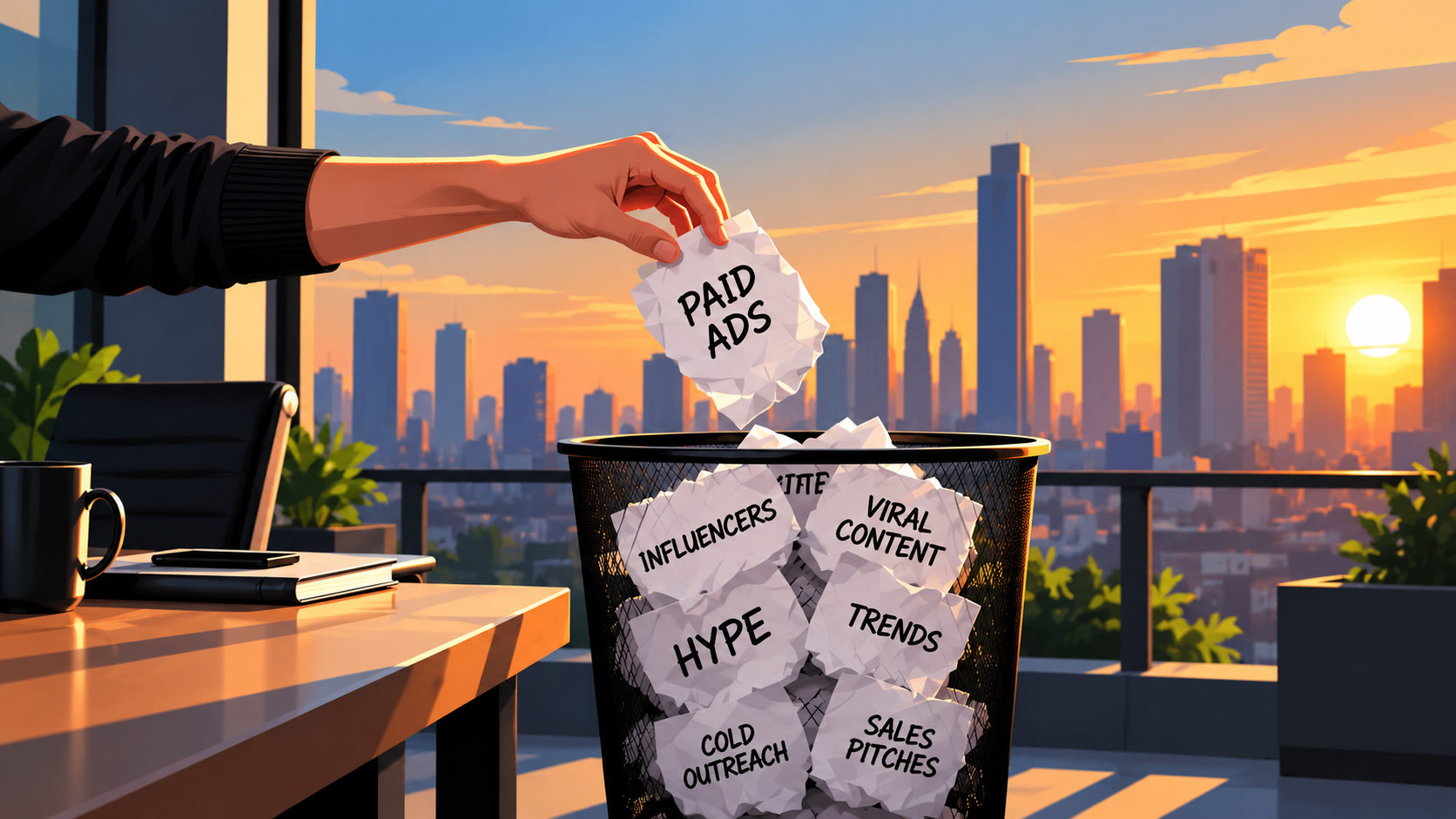
Anti-marketing is the practice of building a brand by breaking the conventions of ordinary promotion instead of following them. Where traditional marketing sells by praising the product, anti-marketing often sells by understating it, joking about it, warning against it, or refusing to explain it at all. The paradox at its center is real: anti-marketing is still marketing. It still aims to build attention, trust and sales. It simply does that by looking like it is not trying to.
The term has been used in two related but distinct ways, and founders should know both. The older, narrower sense describes using marketing tactics to weaken a rival’s brand rather than build your own, the definition Marketing Week’s Mark Ritson used in 2013 when writing about a viral video that gave away Abercrombie & Fitch clothing to homeless people in protest of the retailer’s exclusionary targeting. That usage is closer to brand warfare than to a growth strategy, and it is not what this article is about.
The more common sense, and the one that matters for founders, describes a brand attracting customers by defying what an audience expects a brand to do. A 2007 examination of the trend pointed to early examples that still hold up: Whole Foods built a national retail business with almost no advertising, chef’s choice restaurants stripped away the menu entirely, and Abercrombie & Fitch and Hollister added shuttered storefronts to make shopping feel like entering a private club. The common thread, as one researcher put it at the time, was that customers were tired of being sold to, so brands started attracting instead of promoting.
The most cited case is Patagonia’s “Don’t Buy This Jacket” advertisement, a full-page message the company ran in The New York Times on Black Friday in 2011, listing the water, carbon and waste cost of producing the jacket pictured above the ad and asking customers to buy less. One business school case study found that sales rose by approximately 30 percent in the nine months that followed. The campaign is now taught as a case study precisely because it captures the anti-marketing paradox: a company selling more by telling people to buy less, and doing it with total sincerity rather than a wink.
The most current chapter belongs to Liquid Death, a canned water company that built its identity entirely around not looking, sounding, or behaving like a water brand. Its founder told FoodNavigator that the company relies on social media rather than television or billboards, because that is where its audience’s attention actually sits. Bloomberg reported that the company was valued at $1.4 billion in March 2024, double its $700 million valuation less than two years earlier, built almost entirely on humor, social content and a heavy metal aesthetic rather than a conventional media budget. Anti-marketing, in other words, did not stay a niche curiosity. It became one of the more reliable playbooks for building a consumer brand from nothing.
Why Founders Should Use Anti-Marketing in 2026
Three forces converging in 2026 make anti-marketing more useful to founders now than it has been in years, and none of them are aesthetic preferences. They are structural changes in what paid advertising costs, what audiences believe, and who audiences trust.
The first is the price of paid attention. Meta itself reported that its average price per ad rose 9 percent year over year as of July 2025, and industry benchmarking research has found that blended customer acquisition costs have risen roughly 40 to 60 percent since 2023 across most channels. A founder competing on paid reach against incumbents with far larger budgets is competing on the one axis where a startup has no structural advantage. That is the same lesson from a previous article on this blog: the crack a founder can exploit is rarely the one an incumbent is best resourced to defend.
The second is a documented backlash against AI-generated marketing. A Gartner survey of American consumers conducted in mid-2026 found that 65 percent believe brands are producing too much AI-generated content, and 57 percent say that content has made them less trusting of brand messaging generally. Separately, Canva’s 2026 state of marketing and AI report found that 70 percent of consumers say they can usually spot an AI-generated ad because it feels like it is missing something, and 74 percent said they are more likely to buy from an ad they believe was made by a person. Cadbury leaned directly into this mood in late 2025 with a campaign for its Five Star bar that rejected AI outright, arguing that modern work leaves no room for a human moment. Whatever one thinks of the message, the timing was not an accident. Audiences in 2026 are unusually alert to content that feels manufactured, which raises the relative value of anything that visibly could not have been generated at scale.
The third is a broader retreat from institutional trust. The 2026 Edelman Trust Barometer, based on a survey of roughly 34,000 respondents across 28 countries, found that about 70 percent of people now hold what Edelman calls an insular mindset, meaning they are reluctant to trust, work with, or spend time around people or institutions outside their own circle. For a founder, that finding cuts a specific way: broad, institutional-sounding messaging is competing against a rising preference for voices that feel close, specific and unpolished. A brand that behaves like a person a customer already half-trusts will travel further than one that behaves like an institution asking to be trusted for the first time.
Put together, these three forces describe a market where the traditional move, buying reach and repeating a polished message, is getting more expensive and less believed at the same time. Anti-marketing is not a workaround for founders with small budgets. It is a more accurate read of where attention and trust actually sit in 2026.
Anti-Marketing Strategy for Founders: 6 Tactics That Work in 2026
The tactics below are not a checklist to run in sequence. They are six distinct ways to apply the same underlying idea, attracting attention by defying what a customer expects a brand in your category to do. A founder should pick the ones that fit their product and their own tolerance for risk, not attempt all six at once.
Subvert the category script. Identify the one thing every brand in your category always says, always shows, or always promises, and say the opposite with total sincerity. Patagonia’s move was not clever wordplay. It was refusing the entire category convention of encouraging more consumption, backed by real data about the product’s cost. The tactic only works if the subversion is genuine. A founder who fakes reluctance to sell is easy to see through, and the backlash is worse than saying nothing unusual at all.
Build a voice, not a campaign. Liquid Death’s advantage was never a single advertisement. It was a consistent, recognizable personality applied to every touchpoint, packaging, social replies, customer service, over years. A voice compounds because people start to recognize and anticipate it. A campaign resets to zero the moment it ends. For an early-stage founder, this argues for investing in a distinct tone before investing in reach, since the tone is what a small budget can actually make durable.
Trade paid reach for a smaller trusted circle. Given how insular audiences have become, a founder is often better served courting a few hundred people who will vouch for the product to their own circle than buying impressions in front of a few hundred thousand strangers. Referral and word-of-mouth channels remain the cheapest acquisition paths precisely because they inherit trust the brand has not yet earned on its own. Anti-marketing here looks like deliberately staying small and specific rather than broadening a message to reach everyone.
Prove you are human, do not just claim it. Given the AI-ad backlash described above, the founders who benefit most are not necessarily the ones who avoid AI tools, but the ones who make their process visibly human where it counts, an unedited video, a founder’s own writing voice, a response that could not have been templated. This is a live advantage precisely because so many competitors are moving the opposite direction, toward faster and more generic content production, which is what audiences say they are increasingly tired of.
Use scarcity and understatement instead of volume. Long before the current AI-fatigue moment, brands found that doing less loudly could outperform doing more. Selfridges’ well-known “No Noise” campaign stripped its windows and signage down to near-silence during a typically loud retail season, and Abercrombie and Hollister’s shuttered storefronts made entry feel like a private invitation rather than an open door. For a founder, this can mean a waitlist instead of an open signup, a single hero product instead of a full catalog, or a launch with no announcement at all beyond the people already paying attention.
Let critics do the advertising for you. Reverse psychology works because refusal reads as confidence. Patagonia telling customers not to buy, or a chef’s choice restaurant refusing to offer a menu, both remove the customer’s ability to negotiate and replace it with trust that the brand knows something the customer does not. A founder can apply a milder version of this by being publicly upfront about a product’s limitations or who it is not for, which tends to generate more discussion, and more credibility with the people it is for, than a claim that the product is right for everyone.
Anti-Marketing Is Still Marketing
None of the six tactics above are free, and none are an excuse to skip strategy. Patagonia’s ad still cost a full page in The New York Times. Liquid Death still spends heavily on production and creative talent, just not on the media buys a beverage company its size would traditionally make. Every case in this article involved a deliberate decision, backed by a team that could execute it well, not a shortcut for founders who have not yet worked out who their customer is or what they are offering them.
The risk with anti-marketing is also asymmetric in a way traditional marketing is not. A bland traditional ad is forgettable. A poorly judged piece of anti-marketing, a joke that lands wrong, a subversion that reads as insincere, a scarcity tactic that feels like a gimmick, can do active damage to a young brand’s credibility. The tactic should fit a founder’s actual product and actual voice, not be adopted because it worked for someone else’s.
The Real Question for Founders in 2026
The three forces behind this shift, rising paid acquisition costs, AI content fatigue, and a retreat toward smaller circles of trust, are not going away in the near term. That gives founders an unusual opening. The brands winning attention in 2026 are not the ones spending the most to be seen. They are the ones behaving distinctly enough, and specifically enough, to be trusted by people who have grown wary of everything that looks like an institution talking at them. The question worth asking before the next campaign is not how to reach more people. It is what your brand could say, or refuse to say, that no competitor in your category would risk saying at all.
Also read - Why Small Startups Thrive Before Big Corporations Wake Up





Weekly
Newsletter.
